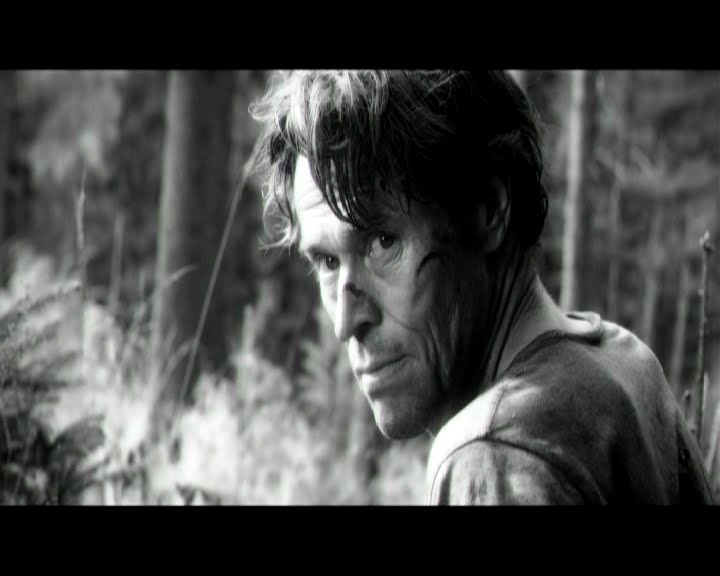
Film review: Antichrist (2009)


Spoilers occur about the ending, this review is intended for those who have already watched the film.

My review is a contribution to the LAMB Lars von Trier director's chair event July 16th.


Summary:
About a couple, the wife (Charlotte Gainsbourg) is writing a thesis and the husband (Willem Dafoe) is a therapist. They spend a large part of the film at a cabin in the woods. The film explores grief, psychotherapy, misogyny, witchcraft, and all sorts of things.
As Lars von Trier said in a press interview at Cannes: "This is a story of a woman who at some level feels a great guilt, and that is maybe why she is doing this to herself"


Analysis:
I disagree with reviewers who say Lars von Trier is merely trying to shock audiences. I would rank it alongside Breaking the Waves as one of Lars von Trier's best. Like that 1996 film, Antichrist takes the imaginative images from his early work and combines it with thought-provoking issues.

I might go so far as to say, the more you learn about the couples' relationship, the less you understand.

As Surrender to the Void writes in his review, "there's a man trying to get into his wife's mind and help her despite the fact that she's not a fan of psychotherapy. Yet, what he finds out isn't just the fact that his wife is troubled but he himself, is someone that might have taken on a role where he's gone too far. The woman is an extremely grief-stricken person who feels responsible for the death of their child as well as the belief from her thesis that all women are evil that has caused her to become psychotic."

I’m not sure the right label is to call it horror. It is without doubt a von Trier-esque film, though. I saw a reviewer describe it as an intense, psychological horror film. On the audio commentary Lars von Trier says: “Maybe it isn’t a horror film, but I set out to do a horror film, that was the starting point”

I think it’s a shame Antichrist utilizes hand held camera like a low-budget documentary similar to previous Danish Dogme films, as the camera-work kept reminding me it was a movie. I probably would have given it a higher rating, if it was shot like a normal film. Anthony Dod Mantle, Oscar winning cinematographer from Slumdog millionaire was on board, so you are treated to some dazzling eye candy at times.

It’s interesting director Lars von Trier on the DVD claims he is atheistic, and made the film as a provocation to himself. He admits it would be ridiculous to say women are more evil than men, he doesn’t think so, but he thinks women are more scared of their sexuality than men. Perhaps because women can become pregnant.

There is a lot to interpret, the title Antichrist, does it imply atheism, at least in respect to the story and characters? Another issue are the animals in the woods, could they be a metaphor for nature giving and taking life. Or do they represent indifferent wildlife and a God who just watches us? Perhaps Lars von Trier is saying nature is beautiful, but doesn't care.


The female lead may not love anything, but it is not explained. Sexuality seems to be a negative element, which is destroying their marriage or perhaps holding it together, it is difficult to say. Something else I found interesting is whether the wife deliberately tied the child's shoe laces together? You could say she has absorbed all these thesis’ about evil women, and perhaps in the process become one herself? Or is it a case of the boy wanting to fly like the teddy and the balloon?


On the audio commentary, Professor Murray Smith says: “She can’t escape from the death of her son. Every time she has sex it reminds her of her son’s death. Lars von Trier: “For me it’s very much a film about anxiety, her anxiety spreading to nature, and to him. He’s taking over her perception. She is using sex to get away from her anxiety”
The guilt is ambiguous. Lars von Trier: “You can easily read it that she feels guilty about killing the boy, her being strangled is him taking over her anxiety." Trier wanted to show that the landscape was something internal, like a Tarkovsky film, for example the scene of the woods fading into the hair.


The ending:

The berries at the end reflect the goodness of nature. On the audio commentary, Lars von Trier says about the ending, he is “trying to be mysterious, because he likes this kind of film. It’s a film that you mirror in people watching it”

The ending is fascinating, what are all those people without faces doing on the hill? Are they seeking something in the woods? This is a film, which demands several viewing to be understood.

Does she want her husband to notice her, is this an explanation of her behaviour? To further make the film even more ambiguous, the child has a name, the man and woman have no personal names.

The wife seems to be caught in a dilemma a lot of women find themselves in, whether to concentrate on their career, or sacrifice these ambitions for the sake of being there for their children.

I also thought the stone bolted to the husband was intriguing, perhaps indicating a marriage can sometimes feel like a burden holding you down? She is hurting him, but does she want him to stay? Why is the cabin in the woods called Eden? You can go on and on interpreting.

Another possible interpretation, perhaps the wife wants her husband to acknowledge the guilt and responsibility she feels, and when he only wants to see the goodness in her, she becomes frustrated and loses her mind. In this light, the film is about the husband disrespectfully not empathizing with his wife's true feelings, and ultimately being a bad therapist.

At the end, Lars von Trier dedicates the movie to his hero, the Russian director Tarkovsky. I happen to have seen Tarkovsky's The Mirror (1975), which is also set in the woods, and Trier says was an influence.

Interview with Lars von Trier about Antichrist (2009):

Interviewer: Do you worry that audiences are numbed by violence?

Lars von Trier: "Yeah, yeah, of course. But when you think about all the footage we now see from real life, I feel like you can show anything. But then when it becomes fictional, there's a limitation. So it's very strange."

Interviewer: Do you worry that people will hate the film?

Lars von Trier: "I don't think about that. I kind of consider myself to be the public. What kind of film would I like to see? How would I like to be provoked? Then some of the audience share my views, some does not. Thank God, some people do react like me! This idea in Hollywood that you can produce a film that will hit a broad audience - and you do test screenings to see when people laugh - it would be impossible for me."


Interviewer: But is the fox a joke?

Lars von Trier: "No, it comes from these Shamanic journeys that I did. It's not like getting onto a plane! Yes, I am still afraid of that. You have a drum beat and you go into a trance that takes you into this parallel world. And there, I talked to this fox and it demanded to have a line."

Interviewer: Did he say anything else?

Lars von Trier: "Well, the first fox I met was a red fox. And it started to split itself to pieces. And afterwards, I met a couple of other foxes. Silver foxes with little cubs. And they said to me, 'Never trust the first fox you meet.' So it was interesting."

Interviewer: Is your movie a Shamanic journey?

Lars von Trier: "That would be very nice. Shamanic journey is very personal. There's nothing religious about it at all. But it's great fun."


Trivia:

It was nominated for the Palme d'Or, and won best female lead performance at the Cannes Film Festival.

Eva Green was considered for the leading lady but rejected because her contract was too complex.

This movie received a special anti-award from the ecumenical jury at Cannes. The jury, which typically awards a film that promotes spiritual and humanist values, decided to award this film an anti-award for its misogynistic views. However, Lars von Trier did not confirm in a later interview that he was a misogynist, saying he loved women and understood Her better than Him.

When the filming started, Lars von Trier had just left a hospital where he stayed for two months, receiving treatment for depression. He had not completely recovered at the time and was even unable to operate the camera as he usually does, which made him very frustrated. He repeatedly excused himself to the actors for being in the mental condition he was, but, according to him, the actors supported him and throughout production, he did not experience any grave problems, except for his own condition.

According to Lars von Trier, he tried his best to make a horror film but did not succeed, and the same happened to him before when he tried to make a musical and the result was Dancer in the Dark.


Verdict:
Considered a film that people either love or hate. Controversial, thought-provoking, challenging, illogical arthouse-horror. However the violent and gruesomely explicit scenes may alienate viewers, Antichrist is not for the faint of heart. Outstanding performances by Willem Dafoe and Charlotte Gainsbourg. A beautiful nightmare, credit must also go to Anthony Dod Mantle's cinematography. It is one of those rare films, which I was still thinking about days after I had seen it. Antichrist is arguably Lars von Trier's most ambiguous and mysterious film to date. If the gruesome scenes had been toned down and the shaky camera idea dropped, this COULD have ranked among my top 25 movies of all-time. That didn't happen, as it is, there are things I love about it, and elements I dislike.
A pity that such a great film excludes viewers with it's moments of ugliness. Definitely the smartest and most symbolic horror film I can remember. As with We Need To Talk About Kevin (2011), Antichrist wants you to feel the pain its characters do. Knowing Lars von Trier is a prankster, perhaps Antichrist was a practical joke. Perhaps he is trying to somehow exorcise his fears and his deepest anxieties through filmmaking. Chaos reigns...

My rating 7.9

Lars von Trier quotes:
Antichrist dvd audio commentary
Rotten tomatoes interview
2009 Cannes press interview


What do you guys think? Was my review useful? Have you watched Antichrist (2009)? Share your opinions in the comments below

This concludes my Lars von Trier marathon, hope you enjoyed my reviews for now!

Film review: Dogville (2003)


Spoilers occur about the ending, this review is intended for those who have already watched the film.

My review is a contribution to the LAMB Lars von Trier director's chair event July 16th.

Summary:
In the US during the depression era of the 1930s, the beautiful fugitive Grace (Nicole Kidman) arrives in the isolated fictional town of Dogville on the run from a team of gangsters. With some encouragement from Tom (Paul Bettany) , the self-appointed town spokesman, the little community agrees to hide her, and in return, Grace agrees to work for them. However, when a search gets underway, the people of Dogville demand a better deal in exchange for the risk of harbouring poor Grace, and she learns the hard way that, in this town, goodness is relative. But Grace has a secret and it is a dangerous one. Dogville may regret it ever began to bare its teeth.

Analysis:
The film is the first in von Trier's projected USA – Land of Opportunities trilogy, followed by Manderlay (2005) and to be completed with Wasington.

Dogville contains at least two stories. Graces story, about a dispute or rebellion against her father. Secondly, Tom’s ambition of being a writer. Grace is the self-sacrificing character, while Tom is an idealistic man, who has big plans.

Tom is a self-appointed moral guardian. He is comparable to Triers other idealists, who want to do good, but cause chaos. Tom sees Grace as an opportunity to throw light on Dogville’s unsound moral values. Yet Tom has his own agenda, his motivation is to gather material for his novel, which he appears incapable of writing. Tom is helpless to everything happening around him.


The ending:
Ebert and Roeper criticized Dogville as having a strongly anti-American message, citing, for example, the closing credits sequence with images of poverty-stricken Americans (taken from Jacob Holdt's documentary book American Pictures, 1984) accompanied by David Bowie's song Young Americans

According to von Trier, the point of the film is that "evil can arise anywhere, as long as the situation is right."

In the New Testament, which chronicles Jesus’ life and death, the merciful God forgives you. In the final scene, Grace decides that the townspeople should be punished for their cruelty, and the Goddess of mercy is transformed into the judgemental Goddess (that we know from the Old Testament).

In many ways, the community in Dogville are pawns in a game they don't know they are a part of. Being evaluated without knowing by who. The audience are likewise in the dark until the devastating climax, but can follow the good and bad choices that are made. You could interpret the film as a lifetime and the ending as a judgement on how you conducted yourself during that life. How you lived your life sums up who you are, more so than words can ever do.
Perceived in this manner, Grace's arrival in Dogville is ambiguous. Is Grace God's vehicle leading the townspeople into temptation and thus revealing their true colours?
Should they be punished if they are just acting on human instinct? Would the community have become evil, if Grace was not so naive? The film seems to be a statement on not exploiting people. Seen in this light, Grace acts as a God at the end of the film, passing judgement based on her own definition of good and evil, and leads to the inevitable question, shouldn't God (Grace) forgive?
If Grace had forgiven the community, wouldn't they have committed more evil acts in the future? Yes, but to sin is human, to forgive is divine. What is worse, to sin or to inflict a punishment in return? These are some of the moral dilemmas Dogville raises. This leads back to Dancer in the Dark.


Staging:
It is a parable that uses an extremely minimal, stage-like set to tell the story.

The bare staging serves to focus the audience's attention on the acting and storytelling, and also reminds them of the film's artificiality. As Surrender to the Void writes in his review, "Lars von Trier has once again made his mark as a groundbreaking filmmaker by just stripping everything down to the essentials."

Dogville is more theatre than film. Classic theatre is dialogue based. The lines in Dogville clarify the character’s nature and the idea of the drama.

The challenge for the actors was to familiarize themselves with the theatre setting, which acted as the mining town Dogville. von Trier asked the actors to spend time on the set as much as possible and be in character. It was a technique he used previously on The Idiots, where the actors were in character off camera.

The voiceover storyteller (John Hurt) conveys what seems to be irony and distance, which has been compared to the German playwright Bertolt Brecht’s theatre methods of the 1930, who Lars von Trier read in his youth. The same period, coincidently as Dogville and Manderlay (the sequel) take place.

As Mette at limereviews writes in her review: "no walls, a village of a dozen houses without walls. And that is so ingenious for countless reasons. The most obvious reason I can think of is that you can see into the houses which is extremely interesting in many scenes, and that you can overlook the whole village in one shot from above. It must also have kept the production cost extremely low – the only thing that might have been expensive in this film are some of the actors. Wonderful and very interesting is also, how after 15 minutes or so, you start imagining the surroundings yourself, which proves that: no, you don't need locations, you don't even need walls”


Interview with Lars von Trier about Dogville (2003):

Lars von Trier: “But the real essence of the whole thing is that the elements that have been taken from theatre and literature are not just mixed up with the forms of expression offered by film. (…) It should be a thoroughly blended and harmonious emulsion.”

Interviewer: There are elements in Dogville, which are reminiscent of classic Anglo-Saxon literature, from Fielding to Dickens, with the omniscient narrator’s voice and the division into chapters, where the chapter headings give an idea of what is about to happen.

Lars von Trier: “That’s true, but it’s more likely I had a book like Winnie the Pooh in mind when I was writing the screenplay. There, at the beginning of each chapter you read things like, ‘In which Pooh and Piglet go hunting and nearly catch a Woozle’, for instance, Things like that, which really get your imagination going. One of my favourite films is Barry Lyndon, which is also divided into chapters, although I don’t remember if there are any clues as to what the chapters are going to contain”

Interviewer: the song The Threepenny Opera?

Lars von Trier: “I listened to that a lot and was really seduced by the great revenge motif in the song (…) We happened to be listening to that song, and I said I could see myself making a film about revenge. I thought the most interesting thing would be to come up with a story where you build up everything leading to the act of vengeance. And of course these days I’ve got this notion that I can only make films that are set in the USA, maybe because I was criticized when Dancer in the Dark came out for making a film about a country I’ve never been to. I can’t really understand that sort of criticism. But one reason for it might be that I criticized the American justice system in the film. And I daresay I know more about America from various media than the Americans did about Morocco when they made Casablanca. They never went there either. Humphrey Bogart never set foot in the town.
These days it’s hard not to pick up information about America. I mean, ninety per cent of all news and films comes from the USA. I reckon it ought to be interesting for American to see how a non-American who has never visited the USA regards their country. And Kafka wrote an extremely interesting novel called America, and he’d never been there either. So from now on I only want to make films that are set in the USA. For the time being, at least. Dogville is also set in the Rocky Mountains, a landscape that has always seemed to symbolize the USA for me. A powerful landscape, run through with deep ravines.”

Interviewer: Did you get the idea for the form of Dogville at the same time as the film’s plot?

Lars von Trier: “No, when I wrote the screenplay I saw it as a conventionally formed film. But it felt boring. Then I went on a fishing trip to Sweden, and wasn’t having any luck! Suddenly I had the idea that you could see the whole of Dogville as though laid out on a map. That the whole story could be told on an unfolded map. I’m pretty fascinated by the limitations that unity of space can give you. Another source of inspiration was one of the best things I’ve seen on television: Trevor Nunn’s adaptation of Dickens’ Nicholas Nickleby (…) What was special about the performance was that it was supposed to look as though it had all taken place on a stage. Nunn edited in shots of the audience now and then, and used other distancing effects too, like the actors occasionally assuming the role of narrator, or the scenery and props being changed in full view. I can also see the influence of one of the classics of American theatre, a play just about every American schoolchild gets to know at some point, Thorton Wilder’s Our Town”

Interviewer: To go back to Brecht, do you see Dogville as a morality play?

Lars von Trier: “Perhaps I do. I often seem to manage to make things quite unclear in my stories, so that the final message is thankfully not entirely obvious. But morality? I’m not sure about that. When all’s said and done, most films are about the fact that man is ultimately an animal who cannot control himself or his environment, but is governed instead by his insatiable desires – and by his stupidity. That’s true of most characters, heroes and villains alike. Fortunately I don’t know any more about man and his nature than anyone else, so I can only come up with a story and shape it according to my own thoughts”

Interviewer: Tom is a remarkable mixture of idealism and calculation

Lars von Trier: “Yes, he’s thoroughly cynical. But then so am I. My first film, the short film The Orchid Gardener, opened with a caption stating that the film was dedicated to a girl who had died of leukaemia, giving the dates of her birth and death. That was entirely fabricated! A complete lie. And manipulative and cynical, because I realized that if you started a film like that, then the audience would take it a lot more seriously. Obviously. Death and sickness are things we have great respect for”

Interviewer: Up to then she has acted as a ‘Goldheart’ character, like the tragic heroines of your ‘Goldheart’ trilogy, Breaking the Waves, The Idiots and Dancer in the Dark.

Lars von Trier: “Grace acts good-heartedly, but she isn’t – and will not be – a ‘Goldheart’ figure. She has to possess a capacity for something else. I tried two or three tricks to get it to work, but I don’t know if it does. This is where the concept of arrogance comes in, a refusal to discuss things and analyse them. So I was happy to let Grace’s father accuse her of being arrogant. She can’t understand this and asks her father how he can say that. And he replies that she is so irreproachably moral that no one can compete with her for righteousness. She feels superior to the other townspeople, who can’t see the difference between right and wrong”

Interviewer: In your ‘Goldheart’ trilogy you had women who sacrificed themselves for a man, an idea and for a task. There’s a different perspective in Dogville. The female lead, Grace, may be willing to sacrifice herself, but there is a limit to her willingness to be sacrificed, and her protest is violent. You’ve evidently had enough of martyrs now.

Lars von Trier: “Women’s vengeance is more exciting. In some strange way it seems that women are better at embodying and expressing that part of me. The feminine part of me, perhaps! I find it easier to excuse myself and my thoughts if I allow them to be expressed through a woman. If I expressed the same thing through a man, you would only see the brutality and cruelty”

Lars von Trier: “One important feature of Dogville is that I wanted the narrator’s voice to be recorded by a British actor. (John Hurt) I don’t want to hide the fact that the USA is being observed from the outside in this film.”


Trivia:
The film was nominated for the Palme d'Or at the 2003 Cannes Film Festival, and won several European Film Awards, including Best Director (Lars von Trier) and Best Cinematographer (Anthony Dod Mantle).

Dogville: The Pilot was shot during 2001 in the pre-production phase to test whether the concept of chalk lines and sparse scenery would work. The fifteen-minute pilot film starred Danish actors Sidse Babett Knudsen (as Grace) and Nikolaj Lie Kaas (as Tom). Eventually Lars von Trier was happy with the overall results. As a result, he and the producers decided to move forward with the production of the feature film. It is featured on the Dogville DVD.

Dogville was meticulously brought to life in a studio in Sweden.

The famed introductory scene of Dogville seen from above was in fact generated by a computer from 156 individual shots. The ceiling of the filming studio was actually not tall enough to make one single, wide shot from above possible.

Manderlay (2005) is a sequel to Dogville, but can be watched without knowledge of the first film, though the backstory does add some layers, if you know what has happened previously to Grace.

Dogville has been compared to Fritz Lang's Fury (1936)

Verdict:
Possibly one of Lars von Trier's most unpredictable films, Dogville again sees Lars von Trier experiment with what the medium of cinema is capable of. The theme of community looks at the dangers and joys of belonging to a group, and the film asks challenging questions of the audience about sin, exploitation and justice, which point to today's society. A strong performance by Nicole Kidman in the lead role, the story has an ensemble feel to it and a great cast. As with Dancer in the Dark (2000), I find the film again to be overlong. Common for many of Lars von Trier's films, Dogville is raw, provocative, polarizing, and not for everyone.

My rating 7.8

Lars von Trier quotes:
Trier on von Trier / Stig Bjorkman (2005)

What do you guys think? Was my review useful? Have you watched Dogville (2003)? Share your opinions in the comments below

Concluding my Lars von Trier marathon, I will review the controversial Antichrist (2009)

Film review: Dancer in the Dark (2000)


Spoilers occur about the ending, this review is intended for those who have already watched the film.

My review is a contribution to the LAMB Lars von Trier director's chair event July 16th. I will post several more Lars von Trier film reviews during July, as he's one of my favourite contemporary directors.

Summary:
It’s the middle of the 1960s in a small industrial city in the state of Washington. 30-year-old Selma (Björk) has emigrated here from Czechoslovakia with her son Gene, who is now twelve. Selma works in a factory making kitchen equipment, but she also does as much work elsewhere as she can to save money for her son’s future. She still finds time to rehearse a musical with the local amateur dramatic group. Selma’s best friend, Kathy (Catherine Deneuve), is a constant source of support and encouragement.
Selma also socializes with Bill (David Morse) and Linda (Cara Seymour), her neighbours in the trailer park where she lives, whom assist her by watching Gene while he is alone. Bill has lost his job, but he is keeping this from his wife. Now he wants to borrow money from Selma. Finally, there is Jeff (Peter Stormare), another co-worker who is infatuated with Selma and does anything he can to help her out.


Analysis:
An international co-production, Dancer in the Dark is Lars von Trier’s third Goldheart film after Breaking the waves (1996) and The Idiots (1998). Many of Lars von Triers films star female lead characters. With the Gold heart trilogy, Lars von Trier has been criticized for a conservative and oppressive view of women.

Sound and music are very important to Selma, because her eyesight is deteriorating. The theme of blindness in Dancer in the Dark fits with the thematic notion of blind justice, which Selma falls victim to. In fact much of the aesthetic of the film, a summer twilight atmosphere, corresponds to her gradual descent into blindness, the loss of sight we can all empathize with.

Selma’s life is a paradox, on the one hand she is a humble, sad, and tragic character. On the other hand, she finds fulfillment and joy through dancing. This paradox can be explained in that her physical emancipation and pleasure stem from day dreams and not reality. As filmforager writes in her review: "von Trier creates a strange melodrama that also acts as something of a commentary on the supposed "American Dream" advertised by splashy old-timey musicals. Only in her fantasies can Selma achieve the kind of sugar-coated joy she longs to experience with her friends and family. She can't even act it out onstage, as her worsening eyesight forces her to drop out of the starring role in a local production of The Sound of Music."

Surrender to the void makes an interesting comparison: "In many respects, von Trier is looking at America in a dream in the same way Stanley Kubrick used London as New York City for Eyes Wide Shut. Really, it's America in a dreamier tone in reference to the Hollywood musicals that Selma loved. Really, von Trier isn't trying to knock America but he knows that he doesn't have to go there to know what's going on since he's pretty much afraid to go on a plane and doesn't like to travel very much."

"If I wanted a boyfriend it would be you, that’s for sure. But I don’t want one. Not now." Selma confesses to Jeff (Peter Stormare), who pursues her. But why does she not want him? Doesn’t she need love and support in her vulnerable situation? And how did she manage to escape communism and reach the US? Couldn’t the eye doctor be persuaded to perform the operation on Gene on credit given the circumstances?

The ending:

Selma becomes a helpless woman in unfortunate circumstances. However, Selma is not completely passive, she insists on not letting the court case be reopened, so her hanging has the characteristic of a suicide, a sacrificial suicide, which she feels is necessary to save her son.

As Bess did in Breaking the Waves, Selma brings her character and her unselfish agenda to its logical end, sacrificing herself for love, and the person she loves the most. Selma has a golden heart, it’s no accident that the three films are called the gold heart trilogy.

The mother-son relationship is ambiguous. Selma’s priority is for Gene to have his eye operation, and her survival comes second. Or has Selma made the wrong decision, is it more important for Gene to have a mother, with the end result for them both to be blind together?


We actually don’t know if Kathy’s (Catherine Deneuve) declarations are true in the final moments, that Gene has been cured and will have grandchildren.

A few American critics were unhappy with the implicit finger-waving at the US judicial system and death penalty, which they found to be too calculated and manipulating, considering von Trier has never been to the US himself.

The camera techniques:

The film was praised by critics for its stylistic innovations. The rules during the making were only fixed camera shots during the musical numbers, and only handheld camera during the rest of the film. Melancholic colours in the reality moments, happiness and radiant colouring for the musical interludes.

The musical sequences were filmed simultaneously with over 100 digital cameras so that multiple angles of the performance could be captured and cut together later, thus shortening the filming schedule.

The camera techniques were complicated to utilize, but gave Björk a great deal of freedom for the song and dance scenes. She could perform them for uninterrupted periods of time, which were covered from all imaginable camera angles.

It is not a true Dogme 95 film, however, because the Dogme rules stipulate that violence, non-diegetic music, and period pieces are not permitted.


Interview with Lars von Trier about Dancer in the Dark:

Interviewer: How come you ended up making another trilogy? First you had the trilogy about Europe, with The Element of Crime, Epidemic and Europa, and now the Goldheart Trilogy

Lars von Trier: “Its probably the fault of you Swedes! Bergman and his trilogies. But it’s fairly practical as well. It’s like being in a department store and buying three pairs of socks in one pack. That’s how films are sold these days, in packs of three. If a distributor wants one good film, he has to buy two bad ones as well”

Lars von Trier: It makes it easier for the critics as well. They can always devote a column to comparing the three films in the trilogy. It’s not unusual in other art forms, after all - painting, for instance, where artists go through different phases and styles in their art, or within music.

Lars von Trier: “It’s the idea of allowing yourself to repeat yourself, like Monet when he painted the same bloody thing all the time. He kept on and in the end they accepted him. He kept going, refining his art. Using the word trilogy indicates that there’s a theme that’s shown in a new light in each film. Or that you’re trying to expand on an idea. It turns into an excuse for concentrating on the same thing once more. Hopefully it won’t be like this for the rest of my life”

Lars von Trier: “someone who sacrifices himself or herself is at least giving their existence some sort of meaning – if you can see a meaning in doing something for others, for an idea, a belief. The characters in these films are struggling to bring meaning to their time on earth. It must feel easier to die if you’re doing it for something you believe in.”

Lars von Trier: "But at the moment I’m at a point in my life where I’ve had enough of elegant camera movements. But I’d always wanted to make a musical. If I was going to do it the classical way, I’d have used a camera crane and a dolly and sophisticated camera choreography, and song-and-dance numbers that had to be recorded in a studio. But that’s what I didn’t want to do. That why it felt important to film those scenes in static shots. It underplays the sense of musical. That’s how I see it, anyway”

Lars von Trier: “Dancer in the Dark wasn’t a Dogme film, so I didn’t feel compelled to follow any fixed rules. But the intentions was always to give an impression of live performance”

Lars von Trier: “I wanted to be able to smother myself in close-ups of the people in the musical numbers. They’re Selma’s fantasies, after all, and she’s populating them with the people around her. And they are themselves in these musical scenes; they act in accordance with their roles in the realistic part of the film. That’s why I wanted to be able to show them in greater close-up – but these shots, of necessity, were far too short”

Lars von Trier: “The musical number on the train was more planned out from the start. And that was also something of a mistake, because that wasn’t the point of all those hundred cameras. Now you can see quite clearly that a large number of shots were consciously composed. Coincidence and chance aren’t as important here. The advantage of the hundred cameras in the train scene is that we were able to film it in just two days. If we’d used traditional methods it would have taken us a month to complete. So the system never worked as well as it should have. Maybe we should have had a thousand cameras. That would have been possible. Cameras aren’t particularly expensive, and they’re getting smaller and smaller and easier to hide around the set. We hid ours or, in certain cases, edited out the ones that ended up in shot.”

Lars von Trier: “Because the songs are born in Selma’s head, and Selma is a humanist more than anything else. She values things that people generally don’t see any value in any more: Noises and human frailty. And this is all turned into music and dance – by thought”

Lars von Trier: “One of the first preconditions for the film was Björk herself. And she was going to write music that would fit the idea of the film; in other words, music that would express both Selma’s humanity and the inhumanity of the musical genre. I think she captured that brilliantly. The idea was to express something similar in the dancing.“

Lars von Trier: "One of the few videos that had impressed me before and that I thought was both attractive and challenging in terms of its choreography was the video for Madonna’s Vogue. Vincent Paterson was the choreographer on that. He’s also choreographed a couple of Michael Jackson videos. So I thought if I was going to have one of those video people, it ought to be him”

Lars von Trier: “I wanted to create a tighter atmosphere and arouse emotions that the musical genre usually holds at a distance. The classic musical is a sort of descendant of operetta. Opera, on the other hand, allows itself an entirely different register and range as far as emotions are concerned, and it was that sort of intensity I was after”

Interviewer: Björk’s performance is remarkable, and admirable considering her lack of previous acting experience.

Lars von Trier: “Yes, her portrayal was practically created in spite of herself. She acted out of pure emotion, and that was naturally very painful for her. And for a lot of the rest of us as well…It’s interesting, because I had never tried to work in that way with an actor before.”

Extracts from The Selma Manifesto – written by Lars von Trier:
“The joy that she (Selma) is able to conjure up from within is her spark of happiness. (…) And she can see all the details…every single one. Strange things that only she can see or hear. She’s a genuine watcher…with a photographic memory. And it’s this double-sided nature that makes her an artist: her love and enthusiasm for the artificial world of music, song, and dance, and her keen fascination for the real world…her humanity. Her art consists of the musical interludes that she takes refuge in when she needs to (…) This isn’t pure escapism!…It’s much, much more…it’s art! It stems from a genuine inner need to play with life and incorporate it into her own private world. A situation might be incredibly painful, but it can always provide the starting point for even a tiny manifestation of Selma’s art. It can be incorporated into the little world that she can control. (…) What she sees at the cinema is flawless…painless…in other words, entirely at odds with real life…(…) they’re Selma’s naïve way of telling a story through a song (…) starts to play with it and forgets everything. The songs are Selma’s dialogue with herself…even if sometimes they are put in other character’s mouths, who express her words, her doubts, fears, joys, and so on. They are naïve songs, with all the well-used words from popular music…but often things don’t work for her…and certain deeper truths seep out…When that happens Selma is quick to turn it all into a game again…playing with words…or fragments of words…like a child!…sheer astonishment at letting sounds come out of her mouth!


Trivia:
Won the prestigious Palme d'Or, and Björk picked up the Best Female Performance Award at the 2000 Cannes Film Festival.

The song I've Seen It All (with Björk and Radiohead's Thom Yorke), was nominated for an Academy Award for Best Song.

Washington State during the mid 1960s was meticulously recreated in Sweden. Some of the cast members in smaller parts are Swedish actors who are dubbed by actors with American accents.

The conflict on set between Björk and Lars von Trier caused a lot of attention in the media, not least at the premiere in Cannes, but didn’t overshadow the actual film. With her eccentric rock star attitude Björk made things complicated, her method acting of completely immersing herself in the role meant that she afterwards claimed it was her last acting job.

The soundtrack for the film, released as the album Selmasongs, was written mainly by Björk, but a number of songs featured contributions from Mark Bell and the lyrics were by von Trier and Sjón. Three songs from Rodgers and Hammerstein's The Sound of Music were also used in the film.

Lars von Trier was not familiar with Björk's music, but had seen a few of her music videos, and was fascinated by her ability to pull faces.

The opening scene is a variation of how it might feel to lose your sight.

As a countermeasure for wearing strong glasses extensively, Björk wore contacts of the opposite level to neutralize her vision during those scenes.

Writer-director Lars von Trier's first draft screenplay was called "Taps" and featured tap dancing in every scene. Choreographer Vincent Paterson convinced von Trier that it would be far too difficult, if not impossible, to teach something as "technical" as tap dancing to Björk and the other cast members within a reasonable period of time. von Trier rewrote the screenplay so that the songs would be more in the style of "traditional" Hollywood musicals, but retained some of the tap-dancing motif with the character of Oldrich Novy

Lars von Trier originally cast himself as the angry man who chastises Selma and Kathy in the movie theater. However, due to the contentious on-set relationship between himself and Björk, he feared that he might end up losing control and overacting, so the part went to Michael Flessas instead.

Verdict:
A scintillating performance by Icelandic singer Björk, considering she had so little acting experience, it is a remarkable feat. The film is an experimental alternative to the sunshiny musicals of bygone years, Lars von Trier has created a mix of fantasy and gritty realism that he believes appeals more to the audience's emotions than intellect.
The story has human emotion in its rawest form, and deals with themes of imagination and naïvety, with a confounding climax. The movie seems to be that rarity that can engage both the arthouse crowd and mainstream audiences. My only complaint is I find the film to be slightly overlong.

My rating 7.8

Lars von Trier quotes:
Trier on von Trier / Stig Bjorkman (2005)

What do you guys think? Was my review useful? Have you watched Dancer in the Dark (2000)? Share your opinions in the comments below

Next, I will look at Dogville (2003) starring Nicole Kidman

In appreciation of The Cure (part 3 of 4)

Album: Disintegration (1989)


Featured in 1001 Albums You Must Hear Before You Die, Disintegration remains The Cure's highest selling record to date, with more than 3 million copies sold worldwide. The album was also a critical success, eventually being placed at number 326 on Rolling Stone magazine's list of the "500 Greatest Albums of All Time".

Stephen Thomas Erlewine of Allmusic called it the "culmination of all the musical directions The Cure were pursuing over the course of the '80s."

In a 1989 interview, Robert Smith was quoted about the album Disintegration. “The whole project was triggered by me writing the words to the song Disintegration around the time of my 29th birthday. It was just the sense of falling apart I can’t really seem to shake off, I think it’s true for everyone really. (…) Getting back to things we used to do with a bit more bite to them, rather than just pop stuff”
(…) I still try and fight against it, the mental decline and the psychical decline that comes with age, your loss of a sense of wonder of things. Having nephews and nieces it has brought home a little more frequently how old I’m getting, just inside my head, not being fascinated by things I used to do, is just a bit worrying, a bit sad. I try and fight against it by doing something like writing songs”

Plainsong – The Cure

(reminds me of Joy Division’s song Atmosphere)


Pictures of You – The Cure

(According to interviews, the inspiration of the song came when a fire broke loose in Robert Smith's home. After that day, Robert was going through the remains and came across his wallet which had pictures of his wife, Mary. The artwork of the single above is one of the pictures.)


Lovesong – The Cure

(The song was a wedding gift to Robert Smith's newly wedded wife.)


Lullaby - The Cure

(The song won Best Video at the 1990 Brit Awards)


Fascination Street - The Cure


The same deep water as you - The Cure


Disintegration - The Cure


Homesick - The Cure


Untitled – The Cure


What do you guys think of the music? Check back next week for part 4 of 4 where I look at my favorite Cure songs from 1992-2000


Robert Smith quotes from:
The Story Of The Cure - Much More Music (2000)
The Cure on That Was Then… This Is Now (1988, BBC documentary)
Out of the Woods - The Cure (2004) (Chrome Dreams)

Film review: Breaking the Waves (1996)


Spoilers occur about the ending, this review is intended for those who have already watched the film

My review is a contribution to the LAMB Lars von Trier director's chair event July 16th. I will post several more Lars von Trier film reviews during July, as he's one of my favourite contemporary directors.

Summary:
Set in a religious community in the Scottish Highlands in the early 1970s, it is about an unusual, young woman, Bess McNeill, and of the love she has for Jan, her husband.


Analysis:
Breaking the Waves is widely regarded as one of the most distinctive European films of the 1990s, marking von Trier's movement toward his influential Dogma 95 school of filmmaking, which emphasizes realistic situations of contemporary life, filmed without background music and with a hand-held, restlessly moving camera.

A riveting and brave performance by Emily Watson, von Trier told her that when she spoke to God, she should speak as a little girl who is talking to a doll. The main character Bess was criticized in reviews for being an improbable character, a childlike martyr who was a bad role model for those who rebel. Also, Lars von Trier was accused of being a manipulator, pushing all the right buttons to make the story shocking and powerful.

The style of Breaking the Waves has a documentary realism. The realism contains elements of allegory, the arty chapter images, which remind us that the film is not just reality. The chapter pictures are nature panoramas with symbolic ingredients, land, sea, sky, which foreshadow redemption and divinity.

As Jan state of mind gradually worsens, he pushes Bess further and further into sexual humiliation: “Let me die, I am evil in the head” Jan writes on a piece of paper to Bess.
In the preface to the book version Director’s Note – This film is about ‘Good’, von Trier interprets Jan as a good person, who’s evil requests aimed at Bess are caused by brain damage and medication. This harmonizes with an earlier scene, which points to, that it was Jan’s initial goodness that provoked Bess to liberate herself sexually without him.
But of course Bess’ newly awakened sexuality may also have been terminated, so she became frustrated. Going along with Jan’s plan fit into her need to express herself sexually.

The other interpretation is she is suffering for Jan’s sake, and there is no pleasure other than helping Jan, and this interpretation is more plausible, considering the religious ending. The American critic Susan Sontag has pointed toward the similarity between sexual obsession and religious obsession. Producer Peter Aalbaek Jensen called the concept of the film a women who is screwing herself into paradise.

Bess submitting herself sexually appears as an act of love, which is to redeem the traumatized troubled Jan. Bess represents the will to sacrifice, an unspoiled goodness, even though she is doing something everyone finds alarming and unacceptable, Jan’s needs precede the values of the community. Emancipation for Bess is in death. The naïve goodness of a woman would be a theme in Lars von Trier’s subsequent work, Dogville and Dancer in the Dark.
We wonder if Jan is saved because love, expressed through sexual humiliation, is healing. Has God accepted Bess’ sacrifice and is rewarding Jan by making him walk again?

The filmmakers could have settled for letting us hear the bells, whereby the miracle would have been possible to interpret as a mental experience, but by showing the bells in the sky there is no denying they exist.
It’s an obvious conclusion to regard the suffering Bess as a female Jesus figure, who lets herself be crucified out of love, “Bess’ sacrifice” as the seventh chapter is named. Bess rises again as a spirit, the liberator and the liberated.

I have read in the early stages of production, the community was Catholic, and was changed to Puritan protestants, because von Trier realized the miracle would appear stronger in a community not believing in miracles. Puritans are hostile towards social pleasures and indulgences.

To confuse matters, the wikipedia page on the film declares the community belonging to a Calvinist church, which apparently is close to the Puritan faith.

In Breaking the Waves, the community is a source of power, whom cast people out, whom have other values, or divert too far from the norm. On a deeper level, Breaking the waves postulates a conflict between the institutionalized faith (the church and the bible), and a personal religion acquired through other channels, for example, experience.


Interview about Breaking the Waves (1996):

Lars von Trier: “I prefer working with extreme ideas, and I wanted to make a film about ‘goodness’. When I was little, I had a children’s book called Guldhjerte (Goldheart), which I had very clear and happy memories of. It was a picture book about a little girl who goes into the forest with some slices of bread and other stuff in her pockets. But at the end of the book, when she’s got through the forest, she’s standing there naked and with nothing left. And the last line in the book was: ‘But at least I’m okay’, said Goldheart. It seemed to express the ultimate extremity of the martyr’s role. I read the book several times, in spite of the fact that my father thought it was absolute rubbish. The story of Breaking the Waves probably comes from that. Goldheart is Bess in the film. I also wanted to make a film with a religious theme, a film about miracles. And at the same time I wanted to make a completely naturalistic film”

Lars von Trier: “As you can see, Breaking the Waves doesn’t follow the (Dogme 95) rules exactly. I wasn’t able to resist tinkering with the film’s colour and technical appearance. Maybe I shouldn’t have done, if I was going to be faithful to my own theory. But I felt a need to restrict myself, and that was the spirit in which the manifesto was created.”

Interviewer: What do you think is unique about your signature? What is it in a film that means that we can see it’s one of yours?

Lars von Trier: “This will probably sound pretentious, but somehow I hope people will be able to see that every image contains a thought. It probably sounds arrogant, and it might not be true. But I think that every image and every edit is thought through. There’s no coincidence at all.

Interviewer: Breaking the Waves has a strong religious background. What made you include that in the film?

Lars von Trier: “Probably because I’m religious myself. I’m a Catholic, but I don’t pray to Catholicism for Catholicism’s sake. I’ve felt a need for a sense of belonging to a community of faith, because my parents were committed atheists. I flirted with religion a lot as a young man. In your youth you’re probably attracted to more extreme religions. Either you disappear to Tibet or you seek out the strictest faith available, with total abstinence and so on.
I think I’ve developed a more Dreyer-esque view of it all now. Dreyer’s view of religion was primarily humanist. He also tackles religion in all his films. Religion is attacked, but not God. That’s what happens in Breaking the Waves.”

Interviewer: In the film, religion is described as a power structure. The mechanics of power and its problematics is something you’ve tackled in several of your previous films

Lars von Trier: “My intention was never to criticize any particular faith, like the one in this Scottish setting. That doesn’t interest me at all (…) In many ways I can understand people who are obsessed by spiritual issues, often in a very extreme way. It’s just that if you’re going to create a melodrama you have to include certain obstacles. And religion struck me as being a suitable obstacle. “

Interviewer: Bess’ conversations with God have a directness and an intimacy that gives a human voice to the religious theme.

Lars von Trier: “Bess is also an expression of that religion. Religion is her foundation, and she accepts its conditions without question. In the funeral scene at the beginning of the film, the priest condemns the deceased to eternal damnation in hell, which is something Bess finds completely natural. She has no scruples about that. But we, on the other hand, do. Bess is confronted with a lot of other power structures, like the power exerted by the hospital and the other doctors. And she has to adopt a position using the inherent goodness that she possesses.”

Lars von Trier: “What I particularly wanted was for Per (Kirkeby) –who’s both an artist and a theorist – to find different ways of expressing the romantic landscape. (…) What he did to the pictures made them considerably more interesting and ambiguous. Perhaps I was aiming more towards the grandiose. (…) I’m very fond of that picture. You can read as much symbolism into it as you like. You can see the bridge as a link between life and death. And the water representing eternity. And so on. But I haven’t really thought about it. Everyone can interpret any perceived symbolism as they like. But I think it’s an expressive picture. And I think it works well with David Bowie’s Life on Mars.”

Interviewer: You’ve often mentioned Dreyer as a source of inspiration. Do you think that’s the case even on this film?

Lars von Trier: “Yes, I can see that films The Passion of Joan of Arc and Gertrud have probably been significant for Breaking the Waves. Dreyer’s films are naturally more academic, more cultivated. What’s new for me is having a woman at the center of the story. And of course, all of Dreyer’s films had women as their main characters – women who are suffering, as well. The film’s original title was actually going to be Amor Omhie (Love is Everything), the epitaph that Gertrud wanted on her grave in Dreyer’s film.”

Lars von Trier: “The priest talks about loving the Word and the Law. That was the only thing you had to obey. That’s what would make a person complete. But Bess twists the concepts and says that the only thing that can make a person complete is loving another person. This is really a formulation of the film’s moral. (…) So what you could say about Bess is that she represents feminism against the extremely misogynist priesthood. And her sister-in-law, Dodo, does much the same”

Lars von Trier: “I think that this strong engagement with emotions was very important for me, because I grew up in a home – a culturally radical home – where strong emotions were forbidden. Those members of my family whom I’ve showed the film to have been very critical of it – both my brother and my uncle, who’s also involved in film. My brother thought the film was indifferent and dull, and my uncle saw it as a total mistake from beginning to end. But otherwise, with my earlier films, he’s been extremely supportive. Perhaps Breaking the Waves is my teenage rebellion.”

Interviewer: The film was criticized by feminist commentators. They reacted against the portrait of Bess sacrificing everything, even her life, for her husband. Breaking the Waves was accused of misogyny and of shameless manipulation.

Lars von Trier: “I haven’t come into direct contact with those accusations. Everyone is entitled to formulate their own opinion of the film”


Trivia:
Emily Watson was nominated for an Oscar, Golden Globe and a BAFTA for Best Performance by an Actress in a Leading Role, and won a European Film Award for Best Actress.
Breaking the Waves won the award for Best Film at European Film Awards, and was nominated for Best Motion Picture - Drama at Golden Globes.
Also won Grand Prize of the Jury at Cannes Film Festival, and was nominated for the Palme d'Or.

The inspiration for Breaking the Waves was a childhood book Lars von Trier liked called Goldheart, a fairytale about a girl who goes into the forest with some crumbs, and on her journey gives away her food and clothes to people in need. She was so kind that she had given everything away.

Verdict:
Breaking the Waves might be too manipulative and controversial for some viewers with its mix of sexuality and religion. However if the powerful story and strong performances win you over, the film is one that stays with you, and can make you question your own relationships, faith, and attachments to community. Arguably Lars von Trier at the peak of his powers, all facets of Breaking The Waves seem to work, and the final scene in unforgettable.

My rating 8.0

Lars von Trier quotes:
Trier on von Trier / Stig Bjorkman (2005)

What do you guys think? Was my review useful? Have you watched Breaking the Waves (1996)? Share your opinions in the comments below

Next, I will look at Dancer in the Dark (2000), which finally won Lars von Trier the Palme d'Or having been nominated several times before.

LinkWithin

Related Posts with Thumbnails