Film review: Happy-Go-Lucky (2008)


Colourful and thoughtful feel good film about trying to see the positive in everyone and everything and tackle life always with a smile. It made my top 10 films watched in 2010 list. A film written and directed by Mike Leigh. Set in contemporary London, about Poppy, a 30-year-old primary school teacher who is out-going, talkative, irrepressible, funny and with uncontrollable energy. A free spirit whose optimism tends to exasperate those around her, and who speaks before she thinks. The film is lifted by Sally Hawkins' award winning and breakthrough performance. According to the director, Happy-go-lucky is a film about openness and generosity of spirit.

Why is Poppy so optimistic, has she always behaved in this way? Would a sequel about how she was as a 20-year-old cast light on her personality? Could it be she is covering up some bad memories? I'm not sure if Poppy is so happy 100% all of the time on the inside, being happy on the outside I think just makes her feel good about herself and towards others. Maybe she wants to avoid hurting people. I think Poppy is confident and believes in herself, she appears to like being who she is, and doesn't let others make her angry. The title describes her attitude in life, according to freedictionary, a happy-go-lucky person is happy all of the time and doesn't worry about anything.


My favourite scenes are the driving lessons with Poppy and Scott (the driving instructor). The two in the car are so different that it's funny to me. Perhaps his reaction to Poppy is saying a lot more about him than about her. It's a lot easier for the driving instructor to change others than himself. Scott is the antithesis of the joyful and open Poppy. She can’t help teasing his obnoxious behaviour, the more she teases, the more he gets irritated. Poppy tries to keep herself from being affected by any negative feelings. She wants to get through to him. Scott is afraid of change.

The use of bright colours emphasizes Poppy’s positive attitude. Sally Hawkins talks about her character on the dvd, and explains “she doesn’t shut up, and thinks she is hilarious, but she doesn’t really care if she is funny or not, she is so un-self-conscious. As much as she doesn’t judge other people, she doesn’t judge herself. She allows herself to be exactly what she is, she sees the humour in things, even in the darkest situations, perhaps when others can’t. She has a huge warmth and compassion for others and is naughty, and has a twinkle in her eye”


The question is, does her extremely positive attitude irritate us the viewers, and the other characters in the story? Yes and no. Poppy doesn’t appear to want to compromise and tone down her behaviour to make people like her more. She is just herself. Doesn't let life or other people get her down. A role model to others, a happy person, Isn't that what we want for ourselves? Making other people smile is a good thing, so it’s tough to criticize. But is it excessive at times to force her cheeriness onto others and fault them for not seeing life the same way? This is what some people might find annoying about Poppy. The scene with the homeless man I think is an attempt to show Poppy curious about something different to her own life. Maybe she feels she can help the man in some way.


An interesting observation I read was that the film questions whether someone like Poppy finds happiness, or simply wills herself into being upbeat? You definitely have to be strong-willed to disregard your own mood, and just be an ever-smiling optimist, no matter how you are feeling inside. Some people are able to do that, others are not. Its kind of self-perpetuating behaviour, in that if you constantly are happy, then you might conceivably begin to believe you really are happy, I guess. It’s a proactive attitude, having the reserves of energy to give smiles can make you feel good about yourself and give you a good reputation among others. As Madonna once said in an interview I saw, if you see yourself as a winner, then you will be a winner. And you could flip that quote around, if you see yourself as a loser, then you will be a loser.

Another interpretation I read is that Poppy is a child at heart, which is why she has a desire to work with children and therefore is dependent on her older flatmate and the fact she prefers to use a nickname as opposed to her real name (Pauline).

A cheerful and lively movie that makes you believe in the goodness of mankind, if you didn’t already.

The tagline is that it's a movie that will put a smile on your face, and it certainly did in my case. Hey, that rhymes ( :

For me, a weakness is that Poppy doesn't really grow in the story. My rating is 8/10.

The interpretations in my review might not please everyone, but the film sure is a conversation-starter!


Readers, any thoughts on Happy-Go-Lucky?

IMDB

Rottentomatoes

YouTube

Songs for your iPod

Breaking Locks -Adam Green

(My 3 selections are acoustic. I'm new to Adam Green, enjoyed the inventive lyrics on Minor Love. Here some “webisodes” filmed to accompany the album)


...

Buddy Bradley - Adam Green


...

Give Them A Token - Adam Green


Readers, any thoughts on this week's music?

Film review: Certified Copy (2010)


In Tuscany to promote his latest book, a middle-aged British writer meets a French woman who leads him to the village of Lucignano. What makes the film interesting is the dialogue and the behaviour of the two leads.

Juliette Binoche won the Best Actress prize in Cannes for her performance, I happened to think the male lead William Shimell was fairly dull and wooden. The dialogue switches between English, French and Italian. I never did figure out why the couple started speaking in French, when they spoke in English for much of the story?

Certified Copy is an ambitious script worth a look from an intellectual standpoint, but isn’t romantic enough in my mind. Frustrating to watch the man and woman play charades with each other and are not just their natural selves. Perhaps the director is saying when over-40 intellectuals flirt, it’s sometimes a game of impressing the opposite sex, and perhaps the innocence and tenderness is no longer at the forefront. More about companionship than desire. I enjoyed the first hour or so, but the charades in the last 45 minutes were a letdown and those scenes were somewhat cold, I thought. Both characters appear to be attracted to one another, but are sort of hiding their true selves behind a mask of games. We can’t know if some of the charades are true feelings, and some are playfulness. You would think they are enjoying this game of charades, as they continue with it for a while. I just didn’t feel a sustained warmth for either of the two leads throughout, possibly because there was not much weakness being displayed, or they just didn’t want to show much frailty. When you are that age, then you’ve obviously built up a guard to protect yourself from being hurt, but this also means it’s tricky for others to see the real you, which at the end of the day is what we all crave isn’t it?, to be understood and loved just for being ourselves? Perhaps the film is saying some over-40s take longer to open up.


Some of the dialogue was memorable and thought inducing, but at times didn’t seem natural. Here are some quotes I liked:

“the copy has worth in that it leads us to the original and thus certifies it’s value (and not just in art, but in regards to people, the façade is the copy that conceals a person’s original, true self)

her son: “you have decided you want to fall in love with him”

on women and art: “they can be attractive enough, but they can be bad for you”

“Simple people don’t care if art is a copy or an original”

“We get upset when a child tells us off, but are happy enough when a writer does”

“even the Mona Lisa is a reproduction of a woman” (Leonardo da Vinci conceivably didn’t even ask the model to smile in that playful way, so is the model the one creating the ambiguity in the painting, and Da Vinci getting all the credit?)


In my opinion Certified Copy could have done with some more humour to lighten up the mood. While I quite enjoyed the monologue at the beginning about art and the conversations the first hour, I only gravitated towards the characters on an emotional level in a few scenes such as the car journey. Won’t go down for me as a cult favourite like Before Sunset, despite the obvious similarities. The relationship is so complex in Certified Copy, that it becomes tough to mirror myself in their feelings. I heard someone call Kiarostami's film a mental work out.

Ebert wrote an interesting review, how the film is about the difference between original art and its copies. Is there, in fact, any difference? Which is the real relationship, and which is the counterfeit? Were they a couple pretending to meet for the first time or a new couple pretending to be married? Perhaps Kiarostami's intention is to demonstrate how the reality is whatever the artist/couple chooses.
Another interpretation I read is that they are not married, nor are they strangers, and that she is his mistress of 15 years and she longs to be his wife, while he is somewhat indifferent to her and probably has a wife. Acting is also a copy, so its like a copy of a copy.

The film certainly has unique qualities, and I’m not sure I understood all of the director’s ideas, and the story would probably reveal more on subsequent viewings. I quite liked the film, just didn’t fall in love with it, although I admit it can be charming to see people gradually falling for each other, just my gut feeling is there is not quite enough chemistry for the film to glue me to the screen. My rating is 7.5/10.

Readers, any thoughts on Certified Copy?

IMDB

Rottentomatoes

Songs for your iPod

Our Riotous Defects (Feat. Janelle Monáe) - Of Montreal

(I like how the lyrics are a story. And colourful artwork, looks like took some time to design)


...

Spanish Sahara – Foals


...

No man's land – Psychobuildings

(number 96 on the link, the sound reminds me of New Order)


Readers, any thoughts on the music?

Film review: A Clockwork Orange (1971)


Not one of my favourites by Kubrick, but still interesting. Based on Anthony Burgess’ futuristic dystopian novel from 1959. Some spoilers here, the review is intended for people who have already watched the film.

I thought to myself that maybe Kubrick had gone too far with the violence. Some have criticized the film for glorifying violence, which is almost balletic with background music by Beethoven.

The story shows the consequences of violent acts. Alex clashes with some authority figures in the story, who seem as bad as he is. But this does not excuse Alex for his bad behaviour. Alex sees his violence as a kind of artistic project. According to page 186 in the cinema of Stanley Kubrick, the director reveals that he wanted to show “Alex’s guiltless sense of freedom to kill and rape and to be our savage natural selves”

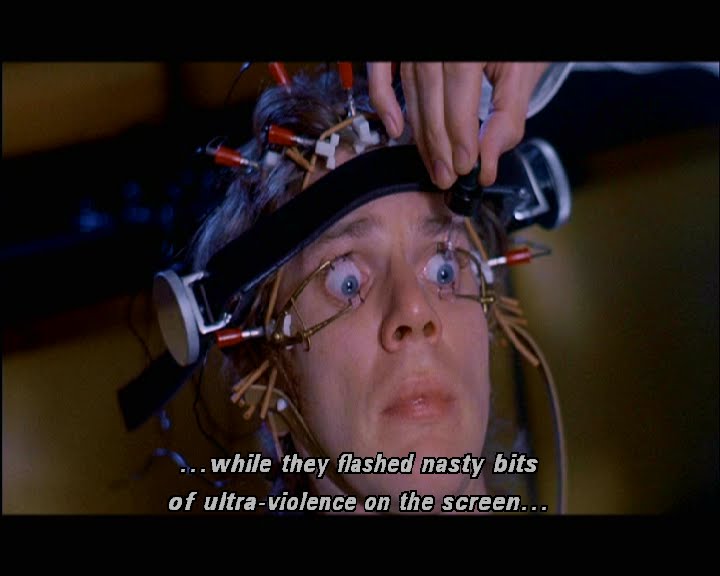
The film is no doubt a critique of the way we punish citizens, or at least a warning that experimental rehabilitation can go too far. Have you been habilitated, if they take away your personality? He has been stripped of his evil doing and been officially cured. He is a new man, he can no longer hurt anyone, but his free will has been removed. Kubrick attempts to make us feel sorry for Alex despite his crimes in the past, the authorities torturing him with straightjacket brainwashing.


According to the book “the cinema of Stanley Kubrick”, the satire is “that a man conditioned to be good in all circumstances is continuously vulnerable”. Kubrick has said that “the goal should be to destroy all authority, so man in his natural goodness may emerge, this Utopian view is a dangerous fallacy. All such efforts eventually fall into the hands of thugs. The weaknesses don’t stem from an improperly structured society. The fault is in the very imperfect nature of man himself”

The film makes a point of saying that we are either a person who can choose, with all the side effects this entails, or we are stripped of choice and are not ourselves anymore. A Clockwork Orange questions, if you can no longer choose between good and evil in your life, are you still a human? And if you are a vegetable, then you can no longer manage to live a normal life in the real world. How do you deal respectfully with criminals, so they have the same rights as everyone? The trouble with free will is it allows you to commit atrocities, despite laws saying you shouldn’t. The film seems to ask, what is more important, free will, or reducing violence? We the audience speculate what is the most humane way to treat criminals.


We can’t be sure if Alex is speaking the truth when he says he wants to be good, one of the prison officers suspects Alex is pretending he wants to be rehabilitated. He goes from being a selfish criminal to being a victim. The way we have increasingly become desensitised these days to violence by continuously and unavoidably being faced with it in popular culture is eerily reminiscent of Alex being strapped down and forced to watch violence, torture and destruction on a screen.


If humans are deprived of the ability to choose evil, can they truly be said to be good? Of course not, because they haven’t chosen to be good, but have been forced by the authorities.


A Clockwork Orange is satirical and Kubrick’s most controversial film. There were several incidents were people claimed to have committed crimes and were inspired to do so by Kubrick’s film. Kubrick's wife has said that the family received threats and had protesters outside their home. Subsequently, Kubrick asked Warner Brothers to withdraw the film from British distribution. The violence doesn’t come across as so bad today, we are used to far worse in mainstream culture, in the 70s, it was heavily criticized.

Anthony Burgess admits, even though he wrote the novel, to detesting A Clockwork Orange in his autobiography. He was quoted in the book "the complete Kubrick":
"I was trying to exorcise the memory of what happened to my first wife, who was savagely attacked in London during the second world war by four American deserters. She was pregnant at the time and lost our child".

A tricky film to interpret and understand. The reckless violence at the beginning is not explained, what is the cause? Boredom? evilness? group pressure? Lack of parental guidance? Probably a combination.


Alex is the extreme case, how could you possibly argue in favour of freedom for a monster such as Alex? Should all humans have free will? This is a moral dilemma.

I hate the soundtrack, they messed with some classical music, other than that, good film, which may look dated in some respects, hair cuts for example, but the theme of how to deal with criminals is still highly relevant today.

IMDB

Rottentomatoes

Readers, any thoughts on A Clockwork Orange ?

LinkWithin

Related Posts with Thumbnails